Prompt2Print — Guardrailed AI for 3D Printing
A Guardrailed AI Workflow for Typography-to-STL Generation
Can AI design something creative with trust?
Prompt2Print turns short text prompts into typography-based 3D designs. The AI proposes bounded aesthetic parameters, while OpenSCAD and deterministic validation rules construct and verify the actual geometry. Failed candidates can enter a bounded repair loop before the user selects a final STL.
AI proposes. Geometry rules constrain. Humans choose.
Built with Jinyu Liu and presented at the 2026 NC Analytics & AI Day as a Duke University student project.
How it works
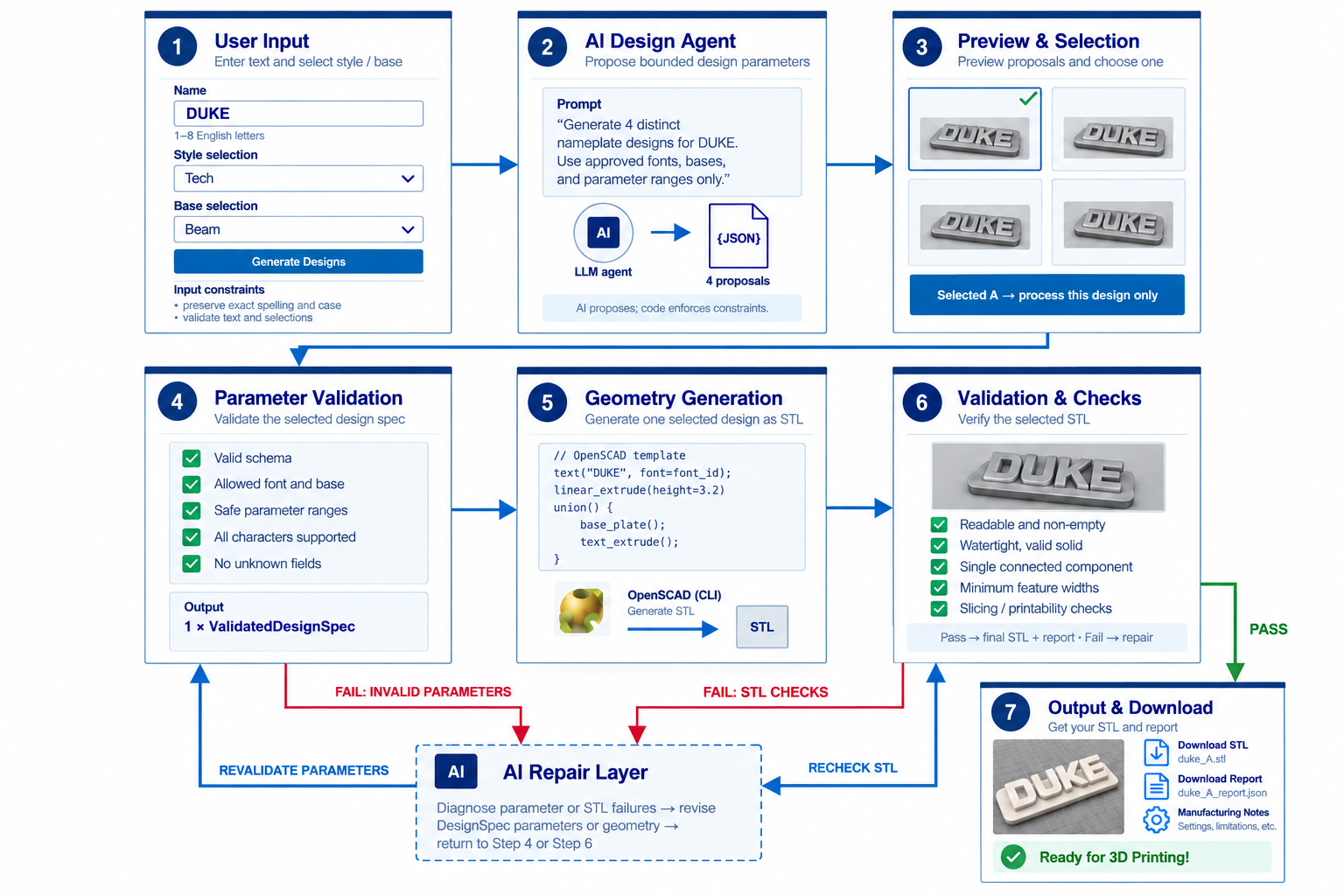
User Input → AI Design → Validation → OpenSCAD → Geometry Checks → Repair → STL Output
The AI generates four structured design proposals without directly creating or validating the final geometry. Deterministic software checks the proposed parameters, builds the STL with OpenSCAD, and evaluates the resulting artifact. Failed candidates can be revised for up to two repair rounds and revalidated before a final artifact is selected.
Results
- STL candidates evaluated
- 160
- Overall pipeline yield
- 81.9% → 97.5%
- Final geometry-gate pass rate
- 85.0% → 98.1%
The conference benchmark covered 40 requests and 160 candidates, with 23 candidates adopting repaired revisions. Three selected artifacts were also successfully printed at the Duke Innovation Co-Lab.
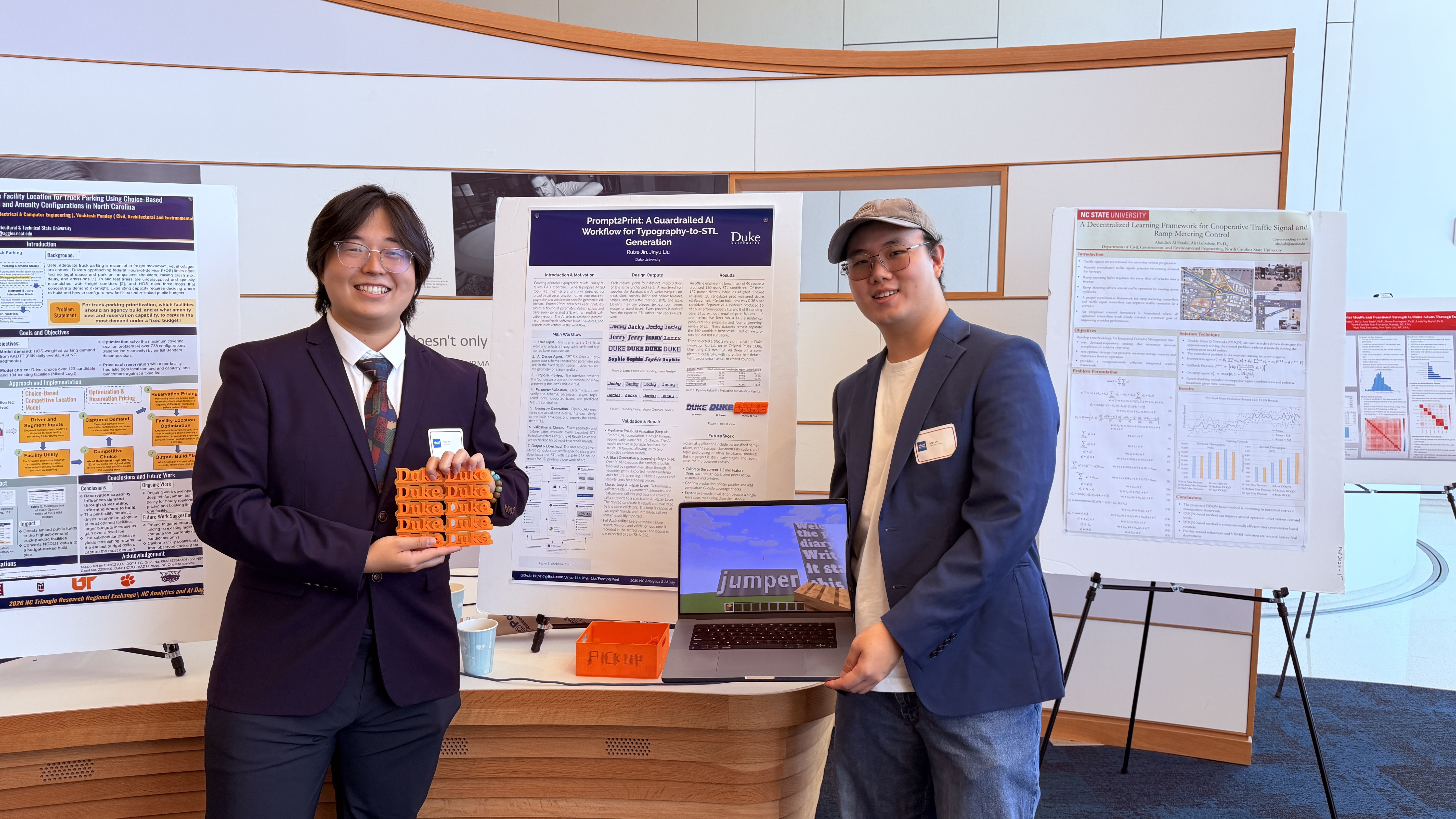
Presented at 2026 NC Analytics & AI Day
Prompt2Print was presented as a student poster project at the 2026 NC Analytics & AI Day. The poster summarizes the workflow, validation strategy, bounded repair loop, benchmark results, and early physical-print evaluation.
View Conference PosterThe conference poster represents the evaluated version presented at the event. The GitHub repository contains the latest implementation and technical documentation.
View GitHub